I am so lostttttt.
Blame it on the distractions.
Blame it on the mindset that I'm part of the generation of Facebook statuses, memes, instagram posts, ten second snap chat stories, and twitter posts.
it's maddening, i tell you.
We so easily accept what is laid out before us.
I get so ecstatically frustrated by the state of things,
by the state of this,
and I feel like the most powerful way I can do anything about it is "post" a status,
a small blurb in the infinite timeline that everyone's eyes are glued to,
that everyone's thumbs can't help but continuously caress,
but it's a place where no one goes for actual deep conversation,
for any sort of compelling thought processes other than cat videos
and what happened on saturday night live last night,
or what our fools in political power have done now.
And more time passes, and we all get older,
and the glacial pace that time takes to carve valleys in our faces
is more and more evident.
Okay, I stole that last thought from a Death Cab song.
But hey, at least i'm listening to music again,
and not just pretending that I'm interested in bands.
I am stuck, and I did it to myself, because I bought into the idea that these modes of expression were real,
only because they were the most direct ways to get right in front of people.
But it's not lasting, it's cheap, and it's sad.
I have become content to obsess over other people's lives,
over images of the pricey coffee they're drinking,
or who went on vacation to Italy,
and someone's new car, or an overly-glamorous selfie.
And I've been part of the whole thing.
I want to be seen.
Look at me.
LOOK AT ME.
Blame it on being a twenty-something who got into a relationship that was way over his emotional scale,
who was completely destroyed by it, and then somehow resurfaced from the rubble like an awkward phoenix,
who shaved his head in a fit of rage,
who forgot about eating,
because sadness just consumes you sometimes,
but don't let it because it doesn't deserve to do that to you.
Who moved to a different city to reinvent himself,
and is really finding it difficult to understand what being human is,
while maintaining healthy relationships with the ones he cares about,
and who now finally at a healthy state is going back to his roots,
the music he made when he was younger,
and learning to appreciate himself,
all of himself,
again.
And so here I am.
I want to express something that's lasting.
I used to work that way.
But I was fooled. I let myself be fooled, and I'm so so so sorry, self.
Please forgive me.
All that to say, I'm still here. I'm not as asleep as I used to be. I'm still breathing. I'm still alive.
Sunday, December 18

Thursday, October 2
The Bad Artist
For me, living as an artist is like holding onto a very long rope. I can't see the other end of it, but it's pulling me that way (whatever "that" way is). I have two choices: let go, or have the patience, will, and curiosity to follow it.
Sometimes, I feel like I'm tied to the rope-- not just holding on. I feel I don't have much choice other than to, "see where this goes," and let the rope lead.
Other times, I feel like I can't find the rope anywhere, that I let go of it a while ago when I wasn't paying attention and now it's gone.
Usually, it has a way of reappearing when I look hard enough.
I've let it lead me this far that I think it would be sad if I lost it completely.
And yet sometimes I wish I wasn't holding onto it at all. There are things somewhere else that look pleasant and wonderful in their own ways, and what might be in my head is to drop it and go.
And maybe I would be happy.
But I know that even then, the absence of the rope would be in my head.
And I would lead a sort of half-life, never having truly seen where the rope lead.
Maybe I'll never, even now, see where the rope is connected.
Maybe it's not really connected to anything, and it's just pulling me through this big place, on its own path, set in its own trail.
I feel honored to follow.
Sometimes.
Other times I feel unequipped and lacking. Things of myself get in the way of following the rope. That is the most frustrating.
This is why I have had trouble confirming within myself that I am an artist. I feel unequipped for the word, but it's what I wish to be, beyond anything. The problem is that I'm not quite there yet. I see that I have much farther to go, so much more to learn, so many gaps to fill, that it's strange to think of myself as an artist.
But I am creative, in my own way. I am dedicated, in my own way. And, occasionally, I am inspired, in my own way. I know this about myself, and I am learning to remind myself through their actions.
I suppose what I want most of all is to be in the good spectrum of the artistic world. That will satisfy me more than any praise I receive for my actions.
I just want to see how far this goes, pretty much.
I hate how much perspective has to do with art. It makes me question what "good" art is, and if I make "good" art. Good and bad is relative to perspective, but yet so many people respond positively to similar things, that there is still some sort of over-arching ultimate gauge in people's heads.
This frustrates me as well...
So all I can focus on is my rope, holding on and following, and letting it take me where it will. I know if I follow it, it will be good. That is enough.
Thursday, August 28
Sooooooooooo
So.
Here we are. Over three months have passed since I walked across campus in my captain gown outfit
 , strolling from the parking lot of my old house to the basketball arena where the ceremonious ceremony took place, where I sat and played on my new intellectual phone while someone on a podium was talking about things I'm sure were very important, but unfortunately inaudible because of the poorly-planned acoustics of the gym's PA system. Our president with his missing thumb said some more things. I looked around and was glad to be surrounded by all of the people that I had studied with over the past four years. All theatre majors, even though I technically wasn't a theatre major. I was actually supposed to be sitting in another section, but, in the style of my educational pursuits, I refused to follow the system and did what I wanted. I sat with my friends, and not with the other BIS majors, who I didn't know at all.
Anyway, that was three months ago. Things are a lot different now.
I sometimes wear hippie clothes. My hair is getting longer. I'm reading East of Eden. While all of my previous younger classmates are, probably at this very minute, sitting in a classroom playing on their phone while somebody in front of them is talking to them about Western Civilization or what have you, I am no longer in that situation. This is the first time this has happened in seventeen years. I'm sitting at a coffee shop tapping my fingers away on a keyboard when I should be in school. Oh the liberation. Oh the freedom.
I haven't blogged in about a year-- like, really blogged. There are a lot of reasons for that, some of which I might go into if I keep this up (but who knows how long that should last!). Let's just say I've undergone quite a bit of change over the past year. Trials, troubles, tribulation, all that jazz. I've passed through the proverbial refining fire and have turned out... refined. Or somewhere close to that. I don't really know what I"m talking about.
Anyway, life has taken new directions, is pretty much what I'm saying. And it's cool and stuff.
I'm "pursuing music," is what I'm telling people nowadays, which pretty much is the easy way to say that I'm trying to set my life up in a way so that the creation and understanding of sonic and tonal relations is more accessible to me, which is the smart, intellectual way to say that I want to be a musician.
It's working pretty well so far. I'm living with a childhood friend of mine, Ben,
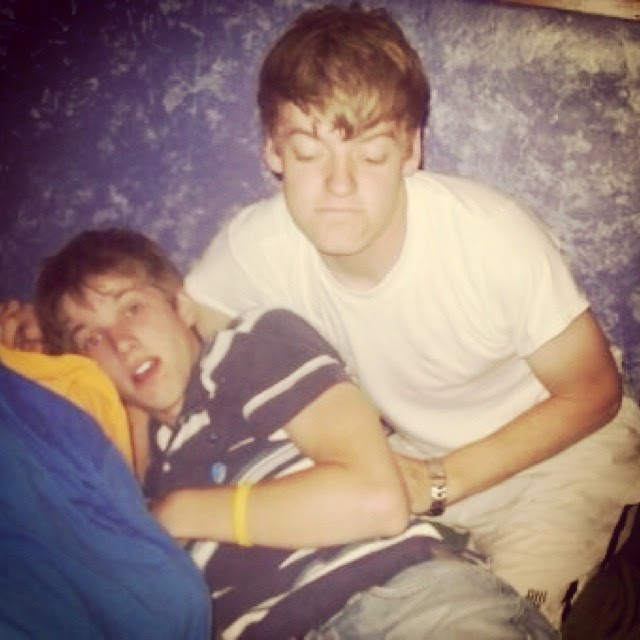
in Hendersonville, Tennessee, about forty-five minutes away from my college town, and this is where we're learning how to make "ART."
Ben is a mastermind in his own right. His speciality is what most people would call "those techno beats." He knows more than most people, and he feels like his curse in life is that no one will ever realize that. Such is the life of the wise men of this generation...
My aim in life is to surround myself with people that I think are better than myself (Like Ben!). This is so that I can learn their trade in whatever area they excel in, and become better at it than they are. And then backstab them and win! That's what I'm planning with Ben, but don't tell him that.
Anyway, I guess this will be the place where I document our progress, where I tell the tale as it trails on into the sunset, or into oblivion, or into success, or failure, or into hamburgers. Who knows. I don't.
Here we are. Over three months have passed since I walked across campus in my captain gown outfit
Anyway, that was three months ago. Things are a lot different now.
I sometimes wear hippie clothes. My hair is getting longer. I'm reading East of Eden. While all of my previous younger classmates are, probably at this very minute, sitting in a classroom playing on their phone while somebody in front of them is talking to them about Western Civilization or what have you, I am no longer in that situation. This is the first time this has happened in seventeen years. I'm sitting at a coffee shop tapping my fingers away on a keyboard when I should be in school. Oh the liberation. Oh the freedom.
I haven't blogged in about a year-- like, really blogged. There are a lot of reasons for that, some of which I might go into if I keep this up (but who knows how long that should last!). Let's just say I've undergone quite a bit of change over the past year. Trials, troubles, tribulation, all that jazz. I've passed through the proverbial refining fire and have turned out... refined. Or somewhere close to that. I don't really know what I"m talking about.
Anyway, life has taken new directions, is pretty much what I'm saying. And it's cool and stuff.
I'm "pursuing music," is what I'm telling people nowadays, which pretty much is the easy way to say that I'm trying to set my life up in a way so that the creation and understanding of sonic and tonal relations is more accessible to me, which is the smart, intellectual way to say that I want to be a musician.
It's working pretty well so far. I'm living with a childhood friend of mine, Ben,
in Hendersonville, Tennessee, about forty-five minutes away from my college town, and this is where we're learning how to make "ART."
Ben is a mastermind in his own right. His speciality is what most people would call "those techno beats." He knows more than most people, and he feels like his curse in life is that no one will ever realize that. Such is the life of the wise men of this generation...
My aim in life is to surround myself with people that I think are better than myself (Like Ben!). This is so that I can learn their trade in whatever area they excel in, and become better at it than they are. And then backstab them and win! That's what I'm planning with Ben, but don't tell him that.
Anyway, I guess this will be the place where I document our progress, where I tell the tale as it trails on into the sunset, or into oblivion, or into success, or failure, or into hamburgers. Who knows. I don't.
Sunday, August 17
A Paper I Wrote About Beethoven's String Quartet in C Sharp Minor for my Music History II class and stuff.
Robert Schumann states that Beethoven’s String Quartet in C Sharp Minor stands, “on the extreme boundary of all that has hitherto been attained by human art and imagination” (Schumann 391).Two aspects about this piece are striking. First, its context— what was going on in Beethoven’s life when he wrote this piece. Second, the quartet’s remarkable state of continuity, which is stressed through two devices: form and tonality. Of utmost importance in this quartet is the fact that all elements work together collaboratively. No movement could exist on its own. This paper will discuss what about the context is striking, as well as Beethoven’s techniques used to establish complete coherency and interconnectedness throughout the quartet, more specifically, the first four movements. Kerman, in his book The Beethoven Quartet, calls the Quartet in C sharp Minor ,“the most deeply integrated of all Beethoven’s compositions” (325). This is why.
To fully understand the weight of Beethoven’s String Quartet in C Sharp Minor, one must understand it relative to its context. While writing this piece, Beethoven’s life was approaching disarray on every conceivable level. At fifty-five, his health dwindling to a pathetic state, he lived alone in Vienna on the third floor of an apartment complex, writing music until his death in 1827. “The mess in his rooms,” Kerman tells us, “was legendary; his appearance was an embarrassment” (Kerman 350). Schumann equated him to, “a crowned lion , yet with a splinter in his paw” (Schumann 18).
Because of his deteriorating health, along with his deafness, Beethoven became increasingly paranoid, which drove him to suspicion of many of his friends, which consequently drove them away. Beethoven was forced to rely on others for ordinary dealings and arrangements; one such care-taker was a young man in his twenties, Karl Holz, who Beethoven became increasingly attached to. Holz eventually resigned from the position and got married, and, like every other of Beethoven’s acquaintances, “simply drifted away after a time.” Towards the end of his life, Beethoven dealt solely with publishers (Kerman 351).
Another important factor to consider, if we are to understand the full weight of this quartet, is Beethoven’s relation to his nineteen-year-old nephew, Karl, of whom he became guardian in 1815. Beethoven felt a strong emotional attachment to Karl, often referring to him as his “son”. Because of the dwindling number of acquaintances, this connection was the only commitment Beethoven had left to care about (Kerman 352).
Because of this desperate, obsessive love, Beethoven “made demands on the child’s love that were as tyrannical as they were poignant” (Kerman 352). Karl, becoming weary of these intolerable demands, grew distant, which then lead Beethoven to apply more pressure, and so the cycle forever ensued until it became unbearable. Karl, in attempts to “free himself psychologically from this senseless domination,” (Kerman 352) shot himself in the head. The suicide attempt was unsuccessful, and Karl spent the next few months in a hospital bed recovering. This deed did not so much affect Karl as it did Beethoven, who “could not “survive the wound caused by the destruction of his one great remaining emotional tie” (Kerman 352). Afterwards, Beethoven reluctantly sent Karl to enlist in the imperial army, though there are indications that Beethoven had hoped to eventually settle down with Karl until he died. “Thus the beloved youth slipped from his grasp and Ludwig was forced to recognize that he had no more power over him. Thereupon he collapsed” (Kerman 353). Beethoven died in March, four months later.
While writing this quartet, Beethoven, approaching the end of his life, was overcome with a sense of aloneness and abandonment. He was a man ravaged by life— deaf, sick, alone at the gates of death, with nothing more to do but await his eventual non-existence. Schumann equated him to, “a crowned lion , yet with a splinter in his paw” (Schumann 18). All that was left in his control was his music, so he wrote. One result of this is String Quartet No. 14 in C Sharp Minor.
Enough scrutinizing can be made about its context, but what it is truly remarkable is the music, itself. It cannot be stressed enough that Beethoven’s goal for this piece was to create a sense of total continuity. The way he goes about this is fascinating. Beethoven broke specific rules of form, going against expectation, for the greater good of creating the sense of cohesion and completeness.
He accomplished this in a variety of ways. First, there are no double bar lines separating any one movement from the other, a method unheard of in that day and age. The players were actually required to move in strict rhythm between movements 2 to 3, 3 to 4, and 6 to 7. Between the remaining movement, players moved directly after a fermata, into the next movement. Beethoven insisted that “there must be no breaks of attention, no catching of breath, no coughs or tuning or uncrossing of legs” (Kerman 326). Through this device, Beethoven stressed continuity, the idea that no movement can truly exist without the others, that each part is integral. Perhaps, also, through this device, Beethoven hints at time’s inability to stand still— that there are no breaks in this eternal existence. There is only a beginning and the story that brings us to the end.
Because each movement is rhythmically tied together so fluidly, the tonal relations between each movement is of even more importance. The quartet moves through six different keys, all of which indirectly relate to the tonic, C sharp minor.
In a review of Beethoven’s Quartet, Wagner states that the opening fugue is, “surely the saddest thing ever said in notes” (Wagner 97). Though it is, indeed, a tremendously expressive piece (indicated by Beethoven’s markings Molto espressivo), being riddled with sadness, it is also quite unique for several reasons. First, it is a fugue, which is strange seeing as most quartets up until that time usually open with sonata form. Not only is it a fugue, but a slow fugue, which is also rare because most fugues in this style are fast. By the first measure, Beethoven is already contradicting the expectations composers usually tie with quartets.
It is important to note that this is not an instance where Beethoven is purposefully being avant-garde for the sake of it. There is a purpose behind this madness, and it is this: if Beethoven were to open with sonata form, he would have only been able to single out one or two keys effectively. However, with a fugue, which travels between keys more fluidly, Beethoven could map out the entire terrain of the movements that are to follow, functioning as a sort of “oracles for the future” (Kerman 328). In order, the Fugue surveys the keys of c#, E, g#, B, A, D, and returns back to c#, which are the keys that the piece shifts through in movement to movement. Through the use of the fugue, Beethoven is foreshadowing the rest of the events of this tonal drama that are to follow in seceding movements. He is giving us a rule-breaking warning of what is to come. The first movement eventually slows into a single drawn out C# in octaves, which “has the amazing quality of distilling and resolving the fugue subject” (Kerman 332), and then it is followed by a fermada.
After the fermada, the second movement begins without hesitation in the new key of D major, which is the Neapolitan key that was already alluded to in the opening fugue. Since D major is related to C sharp in such an indirect way, Beethoven takes special care to protect this new world that he has created.
The movement is in regular sonata form, with the only irregularity being that it is missing a development. In most sonatas, a development is the section of the piece where the music undergoes drastic modulation to enhance the tonal drama. Because of the strangeness of the new key, however, the second movement sonata avoids the development altogether so as not to modulate widely in order to maintain the continuity and flow which Beethoven takes delicate care of throughout the quartet as a whole (Kerman 333).
The lack of modulation and contrast in the tonal drama of this sonata creates the effect of what Kerman calls “flatness,” which effectively protects the new movement’s special key color. Beethoven is emphasizing that dramatic conflict doesn’t necessarily come from within the movements, but between movements that are sometimes, in themselves, flat— between the sadness of the Fugue in C# and the light-heartedness of the Allegro in its Neapolitan key, D. This idea is only possible because of what the Quartet in C # Minor is— an integrative piece, a collaboration between each movement, as well as each aspect, to create something more. “Every aspect of this amazing work serves mutually with every other” (Kerman 333).
At the end of the sonata, the coda does not feel concluded. In fact, it functions more as a hint to the future, giving the listener a sense of expectancy for what comes next. Here, Beethoven ties the second movement with the third. If it weren’t for the coda, the second movement might have been able to stand on its own (Kerman 334).
Wagner says of the third movement, “’tis as if the master, grown conscious of his art, were settling to work at his magic” (Wagner 97) . This third movement is a short, recicative-like segment in B-minor, a key also foreshadowed in the opening fugue. This short movement is a transition, separating the contrasting qualities of movements 2 and 4 (Kerman 334). It also succeeds in confusing the dominant relationship between No. 2, in D major, and No. 4, in A by briefly modulating into E major. The third movement manages to make the fourth movement sound subdominant, which goes along with the subdominant feel that was set up prophetically in the fugue. This movement functions as a distiller, cleansing the pallet, neutralizing the senses, preparing the listener for the next journey.
Though the third movement is successful in separating Movement 2 and 4, it is also equally successful in tying the two together, creating a sense of unity through disunity. The third movement connects itself to the second movement by being in the key of B minor, which is the sixth of the key of D of movement 2. There is also a four-note pattern in the third movement recitative, which plays an important part in the variation theme of Movement 4 (Truscott 108). This way, “this introduction has an even stronger connection with the variation theme than is customary” (Truscott 108).
Though most quartets put the center of gravity in the middle, Beethoven saves it for the ending Movement 7. Instead, the fourth movement is in variation form. These variations avoid modulation from the key of A major, which adds even more to the effect of total tonal congruency and interconnectedness (Kerman 335).
The first variation states the melody. The second variation involves a sort of “rustic dance” signified by Piu moss. There is also a melodic call-and-response which involves a subdominant interval, recalling the theme of fourths established by the fugue. To push the impression further, the third variation calls back to the two-part canonic episode in the opening Fugue between first and second violin, but with a different attitude, in a sort of deranged sort of mind (Kerman 335). Variation 4 reinstates the opening melody, but in Adagio 6/8. In Variation 5, the music evolves from sharp attacks into a a harmonic landscape that one would expect a melody to over-score, but the melody is nowhere to be heard. Variation 6 is the hymn-variation of the piece, which is strange because it is quite dramatic, a quality uncommon for most hymn-variations. The harmony eventually “contorts itself violently,” until an “unforgettable dramatic note of menace” interrupts this pseudo-atmosphere of prayer set up by the hymn-variation (Kerman 336).
For the sake of brevity, I will not be approaching movements five through seven. But the fact remains true for those movements as well as the movements we discussed. Each is connected to the other.
What made Beethoven such a genius was his ability to break rules in order to create a more perfect piece of art. By messing with form and tonality, Beethoven was able to create a sense of continuity within the piece, a feeling of interdependence so that each part plays a vital role, each movement being a link in a chain.
Bibliography
Robert Alexander Schumann, F.R. Ritter tr. ed. (1877). Music and Musicians, Essays and Criticisms. Oxford University Press.
Kerman, Joseph. The Beethoven Quartets. New York: A.A. Knopf, 1967. Print.
Wagner, Richard, and William Ashton Ellis. Actors and Singers. Lincoln: U of Nebraska, 1995 Print.
Truscott, Harold. Beethoven’s Late String Quartets. London: Dobson, 1968. Print.
Monday, July 14
Elo-Quent
I created this video for one of my last classes of my time in college. This is the paper that explains what it is.
If for some strange reason you are interested in the notation for this piece, I can email it to you.
Isaac Middleton
Interdisciplinary Studies
Interdisciplinary Studies
Cortney Basham
May 9, 2014
Elo-quent
Richard Wagner was a prolific composer from the 19th century. He was responsible for composing many pieces known as Music Dramas, which are relatively close to operas. In an essay entitled The Artwork of the Future, Wagner stated in regards to Beethoven’s Ninth Symphony that “the last symphony had been written” (Gourt 730). It is a sad claim, but Wagner thought that at last music has been represented in all its completeness through Beethoven’s Ninth, that Beethoven had discovered music’s full potential in this symphony, and so instrumental music after Beethoven was now futile.
Because of this dilemma, Wagner believed that true artistic fulfillment no longer lied in individualized, centralized effort, such as a symphony, but that art must now be a collective work. Wagner states that an artist “can be fully satisfied only in the union of all the art varieties in the collective artwork” (Gourt 730). In other words, an artist can only be satisfied in the unification of different art forms. In a sense, he is saying a true artist is interdisciplinary. Wagner continues, “in every individualization of his artistic capacities [the artist] is unfree, not wholly that which he can be; in the collective artwork he is free, wholly that which he can be” (Gourt 730).
Wagner states that the best type of collective artwork functions correctly “only when each variety in its ultimate completeness is present in it.” Not only this, but each individual art form must only be fully understood through the “collective communication together with the other art varieties.” The art form is successful “only through the mutual understanding and understandable cooperation of all the art varieties.” Basically, Wagner is saying that good artwork must be contrived from many different elements, which all work cohesively together to create something larger and more perfect than what any could do on their own, so much so that the elements are inseparable once they are together.
This project involved many different disciplines (some I hadn’t really thought about until they faced me during the process of creation). The first property, and the most obvious, is the tap dancing. I started tapping my sophomore year of college when I took a bi-term class under the direction of a musical theatre adjunct faculty Jeremy Benton. I was an English major at the time, but had done a few shows with the theatre department and had taken a few dance classes. This first class, though incredibly simple, got me hooked. Also interesting to note is that because I ordered my tap shoes so late, which were then put on back-order, I went through the entire bi-term without actual tap shoes. The professor nicknamed me soft-shoe, after the style of tap dance. Though this was a mistake, looking back, I think this helped my articulation and groundedness later on. (It’s also ironic, because now, my style is anything but soft-shoe).
The seed was planted. I ended up maneuvering my school schedule around whatever tap classes were offered at Western. The next class I enrolled in was Tap II, which was many steps ahead of where my bi-term class left off; however, the professor, Amanda Clark, seeing that I was serious about learning, agreed to let me straggle along. I think this was the best way to help myself learn— to be thrown out into the deep water with the big fish and have no choice but to sink or swim.
I doggie-paddled, panting and choking, through Tap II, then a year later took Tap III. The other students were all dance majors with their perfect form and bodies, most of them having taken dance classes since they could walk. The next semester, I enrolled in Tap Pedagogy, which is the art of teaching tap dance. This class enabled me to think critically about tap, to truly come to understand the terminology and the world that surrounds tap, which I think aided in my choreography.
Eventually, tap became the thing that I would turn to when my life became difficult. It was my escape. I would spend many nights breaking into the Gordon Wilson Hall dance studios and tap until I couldn’t. I think this is when I actually started to get it. Tap no longer was a thing that I did because my professor told me to, and it was no longer just a set of moves (shuffle, ball-change, maxi-ford, Cincinnati). It started to flow out of me. I started to get it.
Though I have tapped for about three years, I have never choreographed anything before. I had wanted to take a class in choreography, but I was not allowed, because I wasn’t a strong enough dancer yet (and still am not). The only experience I had with choreography was doing someone else’s, and watching other people’s choreography online. (the tapper/videographer I draw the most inspiration from is a hoofer known as Jack Evans. I included a directory to his youtube page in the works cited page).
Since I didn’t have much of a place to start, I decided to work from within. While choreographing this piece, I had also been working on a paper in my Music History class about Beethoven’s String Quartet in C Sharp Minor, which opens up in a Fugue (I included a directory to a youtube video of this in the works cited page, as well). The way the Fugue works is that the violin plays the opening melody, which is then followed by the second violin’s interpretation of the same melody at a different interval, and then the viola’s, then the cello’s, until they all eventually flow together into sameness, all the while attaching themselves seamlessly together. I wanted to create the same effect with my choreography, which explains why I open with Tapper I starting the time-step, followed by the others joining me one at a time— it’s my own rhythmic fugue. The String Quartet also emphasized cohesion and interconnectedness; so, that artistic principle hopefully protruded through the choreography.
Going about recording this posed various problems. First, how could I make it so that every dancer was in line with each other? How could I avoid getting off the beat? How can I get good, clean audio?
To record the video and audio, what I did was this: I recorded the video from my laptop camera for all four dancers to a metronome (120 bpm) coming from my laptop speaker. This solved the problem of keeping every dancer on beat and together, since they’re set to the same metronome. However, this created the problem of corrupting the audio. How can I get rid of the sound of the metronome that’s now muddled with my taps?
I then put headphones on and re-recorded the audio without the video to the metronome. I did the same moves, just with headphones. This way, the metronome wasn’t picked up. I then matched the new audio with the old video and muted the old audio, and it all matched up perfectly.
Herein lies a moral issue that can be raised. Am I cheating? Perhaps a little. Is it that big of a deal? It depends on who you are. For this project, I could find no other way to do it. It was the only way this project could be made possible.
I then took that audio home and recorded several different musical interpretations to that metronome. I experienced until I found something I liked. I wanted to make sure that I followed the principle of interconnectedness, so at times the music intentionally follows the editing and the choreography. I was also careful to make sure that it was something that I truly liked. I had grown tired of settling with projects that I’m only partially happy with. I wanted to truly feel satisfied by the end of it.
I then edited the video takes on Final Cut Express HD, after looking up online how to do it. I had taken a video editing class a few years ago when I was a film major, so I understood the capabilities of video editing, I had just forgotten the technical know-how, but was quickly reminded.
I decided that I would make it easier to differentiate the dancers through different clothing. These clothes represent the four different phases in my life that I went through in college. The first, in the top left, consists of gym shorts and a blue shirt, which is pretty much what I wore during Freshman year, when I didn’t value physical appearance as much. In the second box, I’m wearing a large denim button-down shirt that I was given by Charles Hall, a director of a theatre company for which I’ve worked for two summers, and have had a large, positive affect on my life. The shirt represents that era of my life, when I started to truly get into theatre. In the third box, I’m wearing a cat shirt that belonged to a girl, representing the era of my life I spent with her. In the fourth box, I’m wearing clothes that represent the me that is present. The me that is now. Through the device of costume, I wanted to express, at least to myself, the idea that you affect yourself. The choices that you make now ripple down and affect what you do later.
The initial point of this project was to experiment with the relationship that each artistic element has with another. I asked the question of what would happen if you messed with this relationship? Usually, in choreography, a dancer choreographs something then finds music for it afterwards, or finds a song and puts choreography to it. But what happens if you choreograph a piece, and then write music to it afterwards? What if you edit the video in accordance with the music, with the choreography, or with both? I did find that having control over all of these elements makes it much more accessible to accomplish my artistic vision; however, it is also a lot to handle, and can be a bit overwhelming at times. The results were interesting, and effective to a certain extent, though I do not think I accomplished the feeling of total cohesion and completeness within this video.
The following is the notation for my choreography. I have it split up into four different sections, according to the dancer.
Works Cited Page
Grout, Donald Jay. A History of Western Music. New York: Norton, 1960. Print.
Beethoven, Ludwig Van. "Beethoven String Quartet No. 14 in C-sharp Minor, Op. 131 - Afiara Quartet (Live)." YouTube. YouTube, 14 Feb. 2013. Web. 09 May 2014.
Evans, Jack. "H E I P O a | Jack Evans." YouTube. YouTube, 21 Feb. 2014. Web. 09 May 2014.
Wednesday, September 18
Alright, so I understand that we are all very busy.
And I understand that when you get busy, you start to believe that you are the only one in this world who is busy.
And I don't know if that's an ego thing, or if you just become so consumed in all of the things that you're doing that you forget that there's somebody else out there in the world (a teacher, or a roommate, or a random stranger walking past you) doing just as many things, and maybe more. Who knows...
But, man, I'm busy.
And seeing as this is the place where I can put all things Isaac at the forefront of this one-way conversation, I want to tell you about it.
Not really for sympathy, because I already get enough of that. Maybe for attention, because I'm just as vain as Benjamin Franklin (though not quite as bright). And maybe just so that I can understand, myself, what all exactly I have going on for me this semester. I want to lay it all out there and see if I'm overstating things when I tell people that I can't make it to their dinner party (thanks for asking) because I'm just too busy.
So...
School.
I'm taking fifteen hours, which definitely isn't that bad at all. I was originally at eighteen, but dropped my Stagecraft class because it didn't make any sense to keep it now that I've dropped the Musical Theatre major.
My other classes are these:
Tap III
Design
American Lit. I
Sociology (Oh yeah, I have a test tomorrow...)
Voice Lessons
Men's Ballet
And that's kind of it. Totally manageable.
My American Lit class is pretty heavy on reading. My Design class is just kind of constant. And my Sociology class is pretty fun, but has a lot of new information that I'm still in the process of wrapping my head around. My Tap III class makes me feel like a complete idiot, though I can tell that it's helping me. My Men's Ballet class is killing my body slowly. And my voice lessons require a good amount of attention.
And they're all really fun classes.
In my Design class, we're talking about color theory-- concepts about colors that I never knew existed. It's so cool. It's like Music Theory, at least in the sense that there's a system of statutes that constitute not necessarily what sounds or looks good, but how certain elements interact with each other.
Like, in Music Theory, you can say that F# is the Major 3rd of D.
In Color Theory, you can say that Blue is a Complementary color of Orange.
There's a science behind it. And these aren't actual rules of nature-- they're just ways of seeing thigns that people have created in order to better understand these things in our lives that are just so freaking mysterious. It's really cool.
Okay, sorry, I got sidetracked.
And I actually have to go. I forgot where I was going with this, but I'll continue it later. I'm working and a tester just walked in.
Thank you for reading,
Isaac
Monday, September 9
Change
I've been writing in cursive lately.
It changes how you think about the words that you write. I can't help you understand that or explain it to you-- I guess, if you don't write in cursive, start, and then you'll see what I mean. If you write in cursive, try the other way. Feel the change.
Change.
I hear all the time from people that life is built on change:
Change is caused from within. Something outside of you can actually change. Your environment can change, someone's personality can change. You yourself can change just based on active decision making to bring about that change.
Change is also subjective. Sometimes the only thing that changes is the amount of information that you have about your environment, or your friends, or yourself. Sometimes nothing changes at all, but everything feels different, because you know what you didn't know before-- or you don't remember what you did know before.
Some of these are my ideas. Some of them are the ideas of other people's minds.
Everyone says change is good.
I think that's a perspective that people have in order to make life easier. If you don't let go while things around you inevitably change, as things slip away from you while you're still holding on, there is tension and conflict and life does not go smoothly.
But if you accept change as something that is inherently good, then you accept that change and do not hold on. You move with the change-- you change with the change. That way growth happens. Change happens. And if change is a good thing, then good things happen.
This is all theoretical-- and all I'm really doing is writing in cursive. I do not really know about any of this first hand. Or maybe I do and I don't realize it. These are just things that I've thought about recently.
Right now, I guess I am going through a change. I'm not a Musical Theatre major any more. I don't know if that matters to you. I guess it's kind of a small thing when you look at the big picture. But I feel so free.
It was like there was a voice that had been yelling at me-- that screamed at me when I was younger, and I would listen to it. But then I started to hush it, to silence it, because there were other voices that sounded more authoritative and more truthful and more listenable than mine. And then eventually I stopped paying attention to even those voices because there was un-truth in them. They were voices that were speaking truths, but not truths applicable to me. I realize I'm being so extremely vague.
And so I was listening to nobody-- not myself and not anyone. I just was. And the voice kept getting quieter and quieter and I started feeling more and more miserable and un-self. It was all a volcano that was about to explode.
And it exploded.
And I'm glad it did.
I broke down. I realized I couldn't go on. I couldn't push myself and pull myself in this machine that I don't fit. I have other things. Other talents. Other gifts. A voice in me that was screaming at me to work on those, to mold those, to spend my time with those and make them great. But I kept hushing it and telling it to shut up.
Something in me made me decide that that wasn't good for me anymore-- the hushing up of my voice. I started listening to it. And I listened and listened and it grew louder and louder, and it moved me to break, and I broke. And now I feel very alive.
I'm a nothing major. I scheduled an apointment with an advisor this week, and I'll be looking into a degree in writing.
I feel so relieved. So free. So myself.
I thought you'd want to know.
Thanks for reading my words,
Isaac
It changes how you think about the words that you write. I can't help you understand that or explain it to you-- I guess, if you don't write in cursive, start, and then you'll see what I mean. If you write in cursive, try the other way. Feel the change.
Change.
I hear all the time from people that life is built on change:
Life always changes,
the world around you constantly changes,
the people around you change.
You, yourself change.
Change is caused from within. Something outside of you can actually change. Your environment can change, someone's personality can change. You yourself can change just based on active decision making to bring about that change.
Change is also subjective. Sometimes the only thing that changes is the amount of information that you have about your environment, or your friends, or yourself. Sometimes nothing changes at all, but everything feels different, because you know what you didn't know before-- or you don't remember what you did know before.
Some of these are my ideas. Some of them are the ideas of other people's minds.
Everyone says change is good.
I think that's a perspective that people have in order to make life easier. If you don't let go while things around you inevitably change, as things slip away from you while you're still holding on, there is tension and conflict and life does not go smoothly.
But if you accept change as something that is inherently good, then you accept that change and do not hold on. You move with the change-- you change with the change. That way growth happens. Change happens. And if change is a good thing, then good things happen.
This is all theoretical-- and all I'm really doing is writing in cursive. I do not really know about any of this first hand. Or maybe I do and I don't realize it. These are just things that I've thought about recently.
Right now, I guess I am going through a change. I'm not a Musical Theatre major any more. I don't know if that matters to you. I guess it's kind of a small thing when you look at the big picture. But I feel so free.
It was like there was a voice that had been yelling at me-- that screamed at me when I was younger, and I would listen to it. But then I started to hush it, to silence it, because there were other voices that sounded more authoritative and more truthful and more listenable than mine. And then eventually I stopped paying attention to even those voices because there was un-truth in them. They were voices that were speaking truths, but not truths applicable to me. I realize I'm being so extremely vague.
And so I was listening to nobody-- not myself and not anyone. I just was. And the voice kept getting quieter and quieter and I started feeling more and more miserable and un-self. It was all a volcano that was about to explode.
And it exploded.
And I'm glad it did.
I broke down. I realized I couldn't go on. I couldn't push myself and pull myself in this machine that I don't fit. I have other things. Other talents. Other gifts. A voice in me that was screaming at me to work on those, to mold those, to spend my time with those and make them great. But I kept hushing it and telling it to shut up.
Something in me made me decide that that wasn't good for me anymore-- the hushing up of my voice. I started listening to it. And I listened and listened and it grew louder and louder, and it moved me to break, and I broke. And now I feel very alive.
I'm a nothing major. I scheduled an apointment with an advisor this week, and I'll be looking into a degree in writing.
I feel so relieved. So free. So myself.
I thought you'd want to know.
Thanks for reading my words,
Isaac
Friday, August 30
Mulan
I'm a Senior, which is weird when you think about it, but then not really that strange.
I looked at myself in the mirror yesterday while I was taking a break from rehearsals. (I'm in the show Crimes of the Heart. I'm playing Doc. I'm in two scenes, but they're good scenes, and I'm learning things as an actor).
It was one of those moments where you realize that sometimes those cheesy lyrics in pop songs that you always made fun of actually carry some simple-truth weight to them.
The lyrics like "I stare at the man in the mirror, and I don't recognize him anymooooooore."
Or those deliciously sappy Disney songs that you sing ironically to yourself in the shower.
"Whoooo is that girl I seeeee
Staring straight
Back at me?
When will my reflection show
who I am insiiiiiiiiide...."
I know I'm not the only one who does that. Don 't lie to yourself. You do it, too.
But it was one of those moments. I looked up and I saw myself and I was surprised, really. I looked older and strange and different. I was no longer that awkward, little kid with hair hanging down over his plastic-rimmed glasses with acne and bad posture.
Okay, I still am. But I've changed. I look older. I feel older. Even my eyes look different.
Maybe it's all in my head.
People are constantly changing, and that's a good thing. Not a bad thing. I've changed, but I'm stillv ery much the same person.
Time and the human experience. Such crazy things...
This was a short post. Just letting you know what I've been thinking.
School is going well, Mom.
Wednesday, August 28
passion
I found this song from a book that I'm reading, and I like it very much. Maybe you will too.
I think it's strange how one song can affect so many different types of people.
Like that moment of meeting someone you didn't know ever existed, and then finding out that you like the same music, or have read the same books, or wear the same clothes. And you connect with that person because they're moved in the same way that you're moved. Something resonates in them that also resonates in you.
When you are deeply passionate about something, and if you find someone else who is equally as passionate, then it is two burning people who burn together. And nothing is more beautiful or dangerous than that.
I don't understand the concept of Passion-- being passionate about something.
Some people talk about passion as if it's something that you don't have a choice about. I heard someone talking the other day, and they said "I just don't have the passion for it anymore like I used to." As if it was this energy that used to inhabit their souls, but it somehow magically and sorrowfully left and will never come back. And so the only thing to do is give up.
Or you hear people talking about someone, saying "Yeah. He's a really passionate guy." And sometimes I feel like they say it as if to excuse themselves. As if they were saying, "If I was that passionate, I would be doing the exact same thing as he is." They use Passion as a means to disregard somebody's work ethic and dedication.
People talk about Passion as if it's this fuel that makes whatever task in front of you easier to do.
Sometimes I feel like I live in a passion-less world, and that I myself am passion-less. Even though I sometimes feel myself burning for something, or someone, or somewhere. I feel like I do not burn enough. And I feel like not many people do. But I want to find the ones who burn. I want to find the ones who burn in the same way I burn, and I want to find the ones who burn much more than I do.
Can you choose to be passionate? Can you choose to burn? Or is it something that overtakes you? Something that suffocates you and pushes you forward at frightening speeds and the only thing you can do is hang on and pay attention.
Sometimes I feel like the way I live deadens my passion and numbs me from whatever is pulling me or pushing me or burning in me.
But then I wonder if that is an excuse.
Maybe I am simply letting my life deaden my passion, when really the only thing to do is let my passion bring my life to life.
I guess what I need to do is pay more attention and find the things that make me burn. Even just the tiniest flame. I must find those things and write them down and experience them and become them.
I don't really know why. I don't know what good it does other than the fact that I feel like that is why I am here.
Monday, August 19
Little Boy
Is it just me, or do we all have things about ourselves that we wish were different-- things that we think we could change if we really wanted?
But then you try to change, and you go through all this hubbub of reinventing yourself, because the self that you have isn't the self that you want. And then in the midst of trying to reinvent yourself, you sort of get lost along the way. You find yourself in a weird half-way point between the person that you were that you didn't like, and the person that you want to be, the person that you think you could like.
And everything about you is up in the air, and you're nowhere.
Then you start to forget why exactly you didn't like your old self, and you start to wish for it back, but then you feel like you can't go back, because no one can ever go back, and all that is to be done is to keep moving forward, but you don't know exactly where to go.
Everyone always told me to be myself. But that's very hard when you don't know who you are.
So when you don't know who you are, you start to listen to everyone else and what they think of you, because everyone else likes to tell you who you are--- both your enemies and your friends. And I didn't like what either of them told me because it wasn't who I wanted to be.
They told me that I have a permeable innocence about me,
that I'm kind
sensitive
youthful
genuine
excitable
impressionable
irresponsible
extremely clumsy
forgetful
and just sort of a space cadet.
For years I've tried to change these things about myself, because my enemies would call me these things like they are bad, and my friends would call me these things like they are good, but I always just took it as everyone thinking I'm just safe, boring, and undependable. Someone you can't really have a good time with, but they love you in a kind of arm-over-your-shoulder, bigger brother kind of way.
I always felt like I was a step below everyone else. I guess this might spawn from the fact that I grew up in a completely different environment from the rest of the world, and so for a while everything was so new and intriguingly foreign to me-- things that everyone else just accepted as the way things were, the things you don't bat an eye at but accept it as just a part of your reality, just like breathing. And these things had me burning inside with curiosity, excitement, and worry-- like a little boy.
Little boy. That's what everyone equated me to. I always hated it. I didn't want to be called little, and I didn't want to be called a boy.
The opposite of this would be a Big Man.
I wanted to be that.
That I liked.
A big man.
Not a little boy.
I guess my response to being called a little boy is very little-boy-like. "I'm not a child, I'm a man!"
And so I wanted to change myself. I didn't know what exactly I wanted to be, but I wanted to be something different. Not the little boy. I just wanted to relax more, to not be so dramatically affected by the outside world, because nobody else seemed to be that affected by it or interested in it, and it was cool to not be interested in things and to be un-impressionable.
I wanted to appear like I could hold my own, like none of this was out of the ordinary. I wanted to prove to myself and everyone that I can function in this world that I still secretly think is a total catastrophic, beautiful mess. And the deepest part of me is still staring at it wide-eyed and is burning for it, because I know anything could happen.
I wanted to be the guy that was happening, the guy that everyone was drawn to for conversation. I didn't want people to put their arm over me. I wanted to put my arm over someone and have them call me big brother.
I wanted to be more badass, is technically what I'm getting at. But I didn't realize that in order for anybody to be a badass, they must first understand who they are and go from there. I didn't understand myself, because I was tired of the self that was available to me, and so I wanted a different one.
So I tried to reinvent it.
For the last year or so, I've been different, and it hasn't exactly been better. In fact, I've just been more distant. I've found myself not taking an interest in anything. I've gotten tired of people. I've been an observer most of the time, listening to conversation, listening to jokes, laughing if I find them funny. I stare at people as they talk to each other and I listen to myself think, and I don't take an active part in what's going on, because I've lost the point of it all. I play solitaire on the living room floor and don't talk to anybody. I think this is all because I don't have a self anymore to offer anybody. And when you don't have a self, you play cards with yourself.
That's kind of a lie. I'm sure a lot of self-y people play cards with themselves, and I'm sure they're much more of a Self than I am.
I stopped acknowledging what I want or what I need as a person. I didn't speak up for myself because I had no self to speak up for. And so I do what everybody else wants to do, not what I want to do. And when you do that, you stop.
You drift. You play pool with your friends because they want to. You go out to a bar with your friends because they want to. You don't want anymore. You stop burning, and it's very sad.
But it isn't all lost, because you like your friends. But you just know something is missing in you-- you feel empty.
It's an emptiness like there's a hole somewhere inside of you. But it's not something that can be filled by another person, or an ideal, or a religious figure. It's a bit of you that has disappeared. Gone. Because you let it leave. You made the hole yourself, and only you can fill it back up. And I guess the way you do that is put yourself back. The self that you didn't like, but the self that you can't escape. The self that you will come to love. Because everyone should come to love themselves, because the world is a diverse place and it deserves everyone, especially the ones that don't fit into the technical societal blueprints of what is generically considered cool.
The reason I am coming to these conclusions is because I saw all of those characteristics in another person. And I like that person for those qualities. The same qualities that I hated about myself I loved in another person. A fictional person, no less. A person in a book. Someone who doesn't exist, but they are innocent and good and kind and inquisitive-- not somebody you would find at a bar at two o'clock in the morning living it up with everyone in the world, like how I wanted to be, but am not.
I suppose sometimes to learn to love yourself, you have to see yourself in other people and love them for those reasons.
I just read what I wrote and it sounds very egotistical. I don't know about the things I say sometimes.
So I guess this will be something interesting. I will learn every day to be more like myself, to find myself and nurture myself and let myself grow, because that self deserves it. And the world deserves that self.
Monday, August 12
Personality
I've spent the last sixteen years of my life in school-- which is terribly unimpressive, because now at twenty-one, I look at my brain and find nothing.
I think this is because I don't pay attention, and though I receive knowledge and facts and wisdom, I do not retain it, and in five years, five months, five day's time, my mind feels empty, and it is as if I haven't learned anything at all.
Even in some of my favorite classes at Western-- my Astronomy class, for example, taught by a man whose soul I hope will forever be at the right hand of God, if people have souls, and if God has a right hand. Or I hope his stardust spirit floats forever in the starry void to understand all of life's distant mysteries.
I wish him well, is more or less what I am saying, because he has given me so much. However, I say he has given me so much, but most of the information he gave me I do not remember.
I do not remember how far away the earth is from the sun, or how hot the sun is, or the reason why the universe is expanding at an ever-increasing rate, or how and why the universe will eventually collapse back in on itself, or why there really is no center of the universe, or how to disprove the McGruder Demon theory.
I do not remember the facts. The facts, sir, I do not remember.
But, perhaps the class was still a success, because I am now more aware that such facts do exist, such ideas and concepts do manifest themselves in our universe, and now I am aware that there are things to be known. Perhaps that is all the good that college has done me-- it has made me more curious, more aware that there are things I am not aware of.
Where was I going with all of this? There was a point... Oh.
I've been in school for sixteen years. And the life of the student is more or less characterized by one feature (among others)-- early mornings. And you would think that after sixteen years or so of this lifestyle, I would be okay with waking up at seven every morning, and I could do so with a cheery disposition, and perhaps even a smile to greet the day. Every morning I should rip the curtains from my sunshine-stained windows and let the morning tell me something good. And every morning, i should make ten cups of coffee for myself and everyone else in the house, and I should take ten minute showers and listen to NPR and do some sit ups and push ups and maybe take a morning jog around the block. If I had a dog, I would walk it. Maybe I could stroll to campus with Good Morning on my mouth for everyone around me, and I might as well just carry candy or cough drops in my pocket to hand out to people who look like they've had it rough.
But I am not that guy.
I hate mornings. Usually the first word in the mornings is some expletive or other because I forgot to set my alarm clock and I have to be at work in fifteen minutes. Or I feel drowsy and hung over because of all the substances that I exceedingly put into my body the night before. I walk bleary-eyed into the sunshine streets, sometimes with my fly undone, tripping over my shoelaces, with headphones in my ears listening to Radiohead or Grizzly Bear, because they understand. If I see someone I know sitting at the bus stop, I would not say hello. I would stare at the pavement rolling beneath me and bury my hands in my pockets where I would probably find used tissue paper or a guitar pick or a cough drop that somebody gave me because I looked like I've had it rough.
All this to say, I know I should get used to mornings, but I don't know if I will, or if I should-- maybe I would be loosing all that is characteristic of Isaac if i changed things about myself, like suddenly liking mornings instead of hating them.
Have you ever felt like you're stuck between what you are and what you think you should be?
Or you wonder if what you are really is how you should be?
Or you wonder if what you should be is something different from what you are, but you're not exactly sure what you should be?
Or maybe you are sure what you should be, but you don't know how to change, or if you want to change, or if you can change, or if you should change?
These people changed:
Mahatma Gandhi:
 Originally a barrister of British law until he was twenty-four and moved to South Africa, where he then discovered himself in regards to politics and religion within the next twenty-one years, and eventually became the father of Indian independence and changed the world through civility and love. I wonder what was in his mind in this picture. If he was the same Gandhi that everyone knows, the same one that changed the world, or if it is a different Gandhi, a Gandhi that isn't quite there, a Gandhi that is somewhere else, with thoughts in his head much like the ones that occupy everyone else's heads, thoughts on money, marriage, choice of neck-ties, what he will have for dinner after this. I wonder who told him to cross his arms for this picture, or if he did it himself because he wanted to say something about himself, or if that's what everyone did in those kinds of pictures in those days. Was he proud of who he was, or did he hate himself? Did he want to change, or was he okay with where he was?

And what if he had remained that way? Forever standing matter-of-fact-ly before a camera, arms crossed, year after year accumulating money and becoming a successful lawyer, and loving his wife, and no one would ever blame him for staying that way, until his hair turns white and his face becomes riddled with age, until he takes his last crossed-arms picture and he is no more, and the world continues unchanged. No one would blame him for that, because that is how most of us live. But he was haunted by something, something that drove him mad, something that burst from within him, or into him, and he couldn't help but change.
 Charlie Chaplin the man. No secretive smile, no makeup, no bowler hat. Just a man with disheveled face and hair, grinning timidly---probably about nothing. Sad eyes. A face to say "I don't know what became of all of this, but here it is, and I'm glad you've enjoyed it."
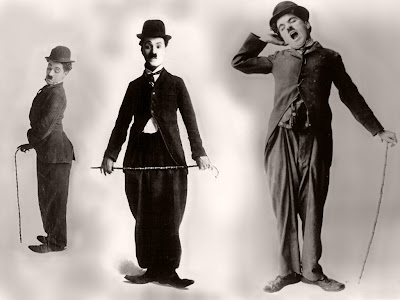 These pictures tell me that it is not only possible, but good, to be more than one thing. To be multifaceted, multidimensional, forever changing and re-changing, going forward and backwards, to stay and to go. To throw up your arms and say I am what I am and then be and not worry anymore. And if what you are is not what you want, then do away with it altogether and start anew. To be a self is to be free, and if you do not know yourself, then let yourself run wild a while and see where it goes. These men I love, because they were never just one thing. They tested themselves, they let themselves go and watched where they took themselves.
They lived and eventually died, and the journey changed themselves and the world. I aim to be like these men. Perhaps I am too hung up on worrying about being in order to become like them.
Perhaps I worry to much.
Perhaps I do not worry enough.
Perhaps I sometimes forget who I am,
and maybe someday I will find who I am,
and maybe I have already found who I am and haven't realized it.
Or maybe there is no real self to find, just different versions of a grander scheme of things that I do not understand.
But I will search myself and I will let myself run free and I will observe and I will learn and I will do so until I die.
I think this is because I don't pay attention, and though I receive knowledge and facts and wisdom, I do not retain it, and in five years, five months, five day's time, my mind feels empty, and it is as if I haven't learned anything at all.
Even in some of my favorite classes at Western-- my Astronomy class, for example, taught by a man whose soul I hope will forever be at the right hand of God, if people have souls, and if God has a right hand. Or I hope his stardust spirit floats forever in the starry void to understand all of life's distant mysteries.
I wish him well, is more or less what I am saying, because he has given me so much. However, I say he has given me so much, but most of the information he gave me I do not remember.
I do not remember how far away the earth is from the sun, or how hot the sun is, or the reason why the universe is expanding at an ever-increasing rate, or how and why the universe will eventually collapse back in on itself, or why there really is no center of the universe, or how to disprove the McGruder Demon theory.
I do not remember the facts. The facts, sir, I do not remember.
But, perhaps the class was still a success, because I am now more aware that such facts do exist, such ideas and concepts do manifest themselves in our universe, and now I am aware that there are things to be known. Perhaps that is all the good that college has done me-- it has made me more curious, more aware that there are things I am not aware of.
Where was I going with all of this? There was a point... Oh.
I've been in school for sixteen years. And the life of the student is more or less characterized by one feature (among others)-- early mornings. And you would think that after sixteen years or so of this lifestyle, I would be okay with waking up at seven every morning, and I could do so with a cheery disposition, and perhaps even a smile to greet the day. Every morning I should rip the curtains from my sunshine-stained windows and let the morning tell me something good. And every morning, i should make ten cups of coffee for myself and everyone else in the house, and I should take ten minute showers and listen to NPR and do some sit ups and push ups and maybe take a morning jog around the block. If I had a dog, I would walk it. Maybe I could stroll to campus with Good Morning on my mouth for everyone around me, and I might as well just carry candy or cough drops in my pocket to hand out to people who look like they've had it rough.
But I am not that guy.
I hate mornings. Usually the first word in the mornings is some expletive or other because I forgot to set my alarm clock and I have to be at work in fifteen minutes. Or I feel drowsy and hung over because of all the substances that I exceedingly put into my body the night before. I walk bleary-eyed into the sunshine streets, sometimes with my fly undone, tripping over my shoelaces, with headphones in my ears listening to Radiohead or Grizzly Bear, because they understand. If I see someone I know sitting at the bus stop, I would not say hello. I would stare at the pavement rolling beneath me and bury my hands in my pockets where I would probably find used tissue paper or a guitar pick or a cough drop that somebody gave me because I looked like I've had it rough.
All this to say, I know I should get used to mornings, but I don't know if I will, or if I should-- maybe I would be loosing all that is characteristic of Isaac if i changed things about myself, like suddenly liking mornings instead of hating them.
Have you ever felt like you're stuck between what you are and what you think you should be?
Or you wonder if what you are really is how you should be?
Or you wonder if what you should be is something different from what you are, but you're not exactly sure what you should be?
Or maybe you are sure what you should be, but you don't know how to change, or if you want to change, or if you can change, or if you should change?
These people changed:
Mahatma Gandhi:


And what if he had remained that way? Forever standing matter-of-fact-ly before a camera, arms crossed, year after year accumulating money and becoming a successful lawyer, and loving his wife, and no one would ever blame him for staying that way, until his hair turns white and his face becomes riddled with age, until he takes his last crossed-arms picture and he is no more, and the world continues unchanged. No one would blame him for that, because that is how most of us live. But he was haunted by something, something that drove him mad, something that burst from within him, or into him, and he couldn't help but change.

 These pictures tell me that it is not only possible, but good, to be more than one thing. To be multifaceted, multidimensional, forever changing and re-changing, going forward and backwards, to stay and to go. To throw up your arms and say I am what I am and then be and not worry anymore. And if what you are is not what you want, then do away with it altogether and start anew. To be a self is to be free, and if you do not know yourself, then let yourself run wild a while and see where it goes. These men I love, because they were never just one thing. They tested themselves, they let themselves go and watched where they took themselves.
They lived and eventually died, and the journey changed themselves and the world. I aim to be like these men. Perhaps I am too hung up on worrying about being in order to become like them.
Perhaps I worry to much.
Perhaps I do not worry enough.
Perhaps I sometimes forget who I am,
and maybe someday I will find who I am,
and maybe I have already found who I am and haven't realized it.
Or maybe there is no real self to find, just different versions of a grander scheme of things that I do not understand.
But I will search myself and I will let myself run free and I will observe and I will learn and I will do so until I die.
Friday, August 9
Talking
I've always heard that when writing, you must say what you mean and mean what you say. But what if you have nothing to mean, and nothing to say?
And what if you don't have the means in you to mean anything?
Sometimes when writing, I feel like I'm just creating nothingness out of nothingness.
What if this is because I don't have anything to say in the first place, and all this writing process is is me gathering up words wandering around in me, and then organizing them into something meaninglessly material?
I always feel like there are other things that are more worth while to say in the world, but I don't know what they are. And there are other writers in the world who could say them in better ways than I could, and we both might be able to name a few.
I feel like I used to have a lot to say, but now I've spent my time being silent, and have taken to thinking to myself where no one else can hear.
Maybe this is out of fear.
Maybe it's out of caution, because I've spent a fair amount of time listening to people talk. And when you listen to someone talk long enough, you realize that maybe they don't quite know everything that they're talking about.
Sometimes that can lead to them lying to you without meaning to.
Or it can lead to them sounding like an idiot.
Soon, they are someone who is just talking. I want to be cautious about that, about just saying things, because I want to only say things that are true. And I want only true things to say.
Perhaps all I am is another mouth.
And so was everyone who ever spoke. Perhaps all the great mouths spoke their words, and perhaps great mouths said foolish things. Perhaps great mouths became great because they abandoned their fear of saying foolish things, and once saying them, found the truth that shook the world. Perhaps to get to the truth, you have to be foolish. And perhaps to be foolish, you have to be honest. And to be honest, you have to consider the prospect that you are a fool.
And always the fear that I am just talking, talking. Talking incorrectly-- saying things that could be said differently, better, more beautifully and simply. Or more complicated and flourishy. And sometimes I make up words like "flourishy," and suddenly begin questioning my entire understanding of the English language.
I am so aware of the things that I am unaware of. And I have little understanding of the things that I claim to understand. And even that is an unconscious shout-out to Confucius.
I feel like the world is an ambiguous place where nothing is exact and nothing can be certain. And yet the people that live in it are so afraid of the ambiguous. The world is so unknowable, and yet we are all afraid of the unknown.
And we are all participants of that-- in the game that this world is the playing field for-- in the knowing and in the being known. And so few of us are known-- truly known. And so few of us know. And even fewer of us know each other. And maybe that's what this is about. To know and be known. To be subjective and objective, both the object being seen and the subject who sees. The Life of the Mind by Hannah Arendt speaks of this, which is another book that I started but never finished, because I started another book that I never finished, because I started reading On The Road by Jack Kerouak, which I haven't finished. I need to finish that. Perhaps that is what I will do right now.
Thursday, June 20
Obscure
So this summer I'm right where I was last summer. Acting in some obscure plays at some obscure theatre in a meeting room tucked away in a state resort park tucked away in a corner of Kentucky, tucked away in one of the more obscure parts of America, tucked away like all the other countries in the world are tucked away, just as tucked away as the earth is tucked away in an obscure part of the universe, which is in itself a very obscure, tucked away thing.
My life is obscure and tucked away, I guess.
I get to start every day in a bed by a window where sunshine shouts at you at eight a.m. telling me to wake up and live. And then I get to drink coffee (out of a bowl because we have a limited amount of coffee mugs) that my roommate made because he always wakes up before me to read books I've never read. I then spend the first part of my morning watching the sun shine off the surface of the lake, interrupted by ripples to create this spectacle like nature's disco ball, but I never want to get up and dance because I still have the sleep in my eyes that I accumulated the night before because I stayed up way longer than I should have, locking myself in my roommate's car to find some sort of real quiet (car's can unsurprisingly function as silent sanctuaries) so that I can play music and sing and write and create and stuff.
Hey so acting is fun sometimes. I'm learning a lot about it. At least, more than I knew before, which is a lot for me and maybe not that much for you if you're an actor.
I'm learning from who I think to be a great actor, Charles Edward Hall, who has played Santa Clause in radio city in New York for the past twenty-six years. He has a lot of insight about the art. He talks about how as an actor you need to first know yourself. In order to fully understand the character you are playing on stage, you must first know who you are, how your character relates to the character. The emotions, the state of mind, the objectives and the tactics of the character, are all things that you can access only if you know how you yourself function. So Socrates's two words "know thyself" is pretty applicable.
Anyway, so that's acting right now.
Right now I'm reading Walden by Thoreau, which is a pretty heavy book. It was written around 1869, but it always feels like his words are more applicable and necessary for this day and age than it was then. He is seeing everything that is wrong with his society and how, if we truly wanted, we could make it better. We are born into one way of doing things-- not necessarily rules and regulations, but ideas that we accept unconsciously as just being the way things are. And these ideas are, in his words, forcing us to "dig our own graves," while we voluntarily reach for the shovel because we think it's the only thing we can do. He, as a philosopher, sees this problem, and offers a solution, which is pretty much why he wrote the book.
And recently I have been listening to:
The National's new album Trouble Will Find Me
Sigur Ros's new album Kveikur
Eisley's new album Currents
Radiohead, as always.
Yup. I think I sufficiently caught myself up with what's going on with me.
Monday, May 27
Number One
I've realized that I don't express myself musically to people very often. This is a skill that I work every day towards: to be able to sense my own emotions and then bring them to life through musical means. But I never give myself the option to do so, usually because I give the excuse that I am either too busy to get anything together, or because whatever I did put together I was never completely happy with and ended up scrapping the whole thing. I realized that I needed to create an environment that didn't have too high of standards. A place where I could express myself any given day through music and share just that with people, without any preconceived notions that it'd be a perfectly thought out idea. Mistakes and all would be welcome, because the mistakes are what was happening with me in that instance on that day. It's like an imperfect musical journal, I guess. A public musical journal. Or blog. Music blog. Yeah.
So the idea is that I'm just going to upload musical sketches onto Soundcloud and then post them on here and maybe blog about them. They won't even be perfectly thought out ideas. Just feelings. Or the metaphors of feelings, or people, or longings.
So I guess this is a privileged area to be: I'll be sharing my mistake-ful ideas with all of you. Whether you will want to listen or not is up to you.
https://soundcloud.com/isaacmiddleton/vices
Here's number One.
Monday, May 20
Hey.
I'm kind of back, I guess.
I took a break form the social media world for maybe a good four months. I'm not sure why. Actually I am. I wanted to see if I could go without Facebook. I could, for a while. And then I realized the sad realization that Facebook is a necessary evil in order to function in the social world. Actually I'm not quite sure if I believe that, or if I'm telling myself that in order for me to feel better about finally caving in and reactivating my account.
I think I'm going to try to be a lot more honest about things on this blog. Actually, that might be a lie. I might act like I'm being honest about things, but am actually lying in order to make myself feel good. Wow. I'm suddenly realizing that maybe I should rename this blog "The place where Isaac either lies or tells the truth in order to make himself feel good."
Have you ever had the feeling that you're losing touch with yourself? Like, the person that you were three years ago was pretty awesome, even though you didn't realize it then. Actually you were self-conscious as hell back then, and you never thought of yourself as pretty awesome, but nobody else could really tell, or maybe they could, but that self-consciousness was a part of you that made you awesome.
But the you now is kind of a degraded, shittier version of what you used to be, and you wish you could somehow trace back your steps, revert back to that version, but you're not sure how, and you're not quite sure how you got to the place that you are.
Or maybe the self-conscoiusness that you're feeling now, that haunting idea that you're losing touch with yourself, is actually playing in your favor and is just as good a part of you as it was back then, but you're too short-sighted to see it.
I deeply wonder if my major in Musical Theatre has made me a worse person overall in three year's time. Was it a mistake that I chose this? It didn't seem like a mistake at the time. It seemed like such a struggle to choose the major. Now it's such a struggle to stay in the major. I feel like I'm softly killing my soul with each semester of it that I tuck under my belt. My soul and my intellect.
When I first came across the Department, they all seemed to have something that I so desperately wanted, but wasn't sure what it was. Self-confidence? The ability to stand on a stage and have people look at you and be good at being watched. The ability to act and sing and dance. I wanted that. I think...
I see pictures of friends of mine on facebook who have graduated from the department, and in the picture they are singing their souls out on their knees to a big number from Chicago or something on some second-rate stage in Philadelphia, and I can't help but silently giggle to myself at how pitiful it all looks. How unconvincing and cliche it all is. But that's me up there. That's what I'm training to be. I don't want that. I don't want to look like that. Get me out! I don't want to act a song!
I'm the guy in my Musical Theatre styles dance who cringes when we're warming up to songs from Rent, because musically it's heart-renchingly terrible. I'm the one who is doing his tondu's in a manner that screams that I probably shouldn't be in that studio. I'm the one in my acting class that makes everyone have to uncomfortably look at the floor because they don't want to have to witness the horrible catastrophe that is happening before them as I spout out my monologue in a way that firmly states that I have no idea what I'm doing. I'm that guy! And the tragedy is that I'm good at other things. Other things that I'm not taking the time to study, because you can't exactly study how to be a singer/songwriter at Western Kentucky University. But for some reason I landed myself in Western Kentucky University. I'm not sure how. i just kind of showed up. I popped out from Mexico and showed up at Western without asking any questions, and then I was invited to audition for a musical, and for the next three years I spent training how to be that silly man on a stage singing his guts out, and I don't want to be him!
WHAT AM I DOING?
I'm having a severe mid-college crisis, and I'm not sure what to do.
When I chose to be a BFA Musical Theatre major, I felt somewhere deep inside me that perhaps this was the wrong choice. But I had to make A choice. I had to. Otherwise, I would never graduate. But maybe I made the wrong choice. Maybe I did. I think I did, and I don't know if I can undo it. And I don't know if i can make myself move forward.
I thought maybe after college I could pursue a graduate studies in Music. Nope. In most colleges, you need a BA in music to do so.
Did I make the wrong choice?
In the meantime, I'm a bit stuck. I have a summer job at a tiny theatre company in a tiny town in Kentucky. I will be very isolated, however, with a lot of time to think. Perhaps I will come to some conclusions. And the semester coming up, I am in the cast for the mainstage Crimes of the Heart, where I'll be playing the role of Doc-- a mysterious thirty-year old married man who is in love with this girl who left me ten years ago, and has suddenly returned. It's interesting, but I don't know how good of a job I will do, or how much of me wants to do a good job.
I'm frustrated. Yes, I am.
Friday, March 1
Darth Vader on a Toilet
This is a roughly finished version of a short story that I'm submitting to a fiction writing competition at my university. I thought you might find it interesting, maybe. The story is somewhat based on childhood details and events, mixed with fiction. Enjoy:
I looked between my legs into the
contents of the bowl and wondered if Darth Vader ever had to go to the
bathroom. I wasn’t allowed to see any of the movies, but I doubted it. It was
hard to imagine a dark lord of such great and terrible power to be sitting in
such a vulnerable position as I was just now. And yet, there I was, a miniature
dark lord myself, propped up on the porcelain pot, my shoe laces dangling to
the tiles.
The
bathroom stall looked foreign and dark through the eyes of my helmet. If Mom
were to walk through the stall door right now and bend down and help me up, I
would see the look on her face that I knew, but could never put into words.
Tiredness, I guess. Anyway, whatever emotion it was, I would be able to see it.
But she could never see mine. All she would see is Darth Vader. Expressionless
and unknowable, shrouded in a shadow of mystery. I could be smiling or crying
and she would never know. No one would ever know. Not even the bathroom stall
walls that rose so high above me. Not even the four letter words that were
scratched into them. I guess I didn’t understand those words, either. I think I
heard Mom say a couple of them when she got really angry. But I knew them for
what they were: words. Simple words. They couldn’t know me at all. I was in a
mask. I wasn’t simple, anymore. I was unknowable.
Just
for the record, I hate it when Mom comes and checks on me. I’m a grown boy of
seven and a quarter. I think I can go to the bathroom correctly by now. Moms
are weird. They care for you so much that it’s suffocating, to the point that
you don’t know what’s driving it—love, or just a desire to torture you while
you’re young and defenseless. Earlier today, for instance. It was a little past
five (I knew, because I had picked up Mom’s watch that was lying on her dresser
next to her glass box of jewelry that Becky was never allowed to touch), and I
was looking at my Darth Vader costume in
her mirror that was bigger than me. I lifted my hands and tried to move the
mirror with my mind, the way Darth Vader would. Right when I was convinced it
was about to budge:
“Honey, get down from the dresser, and where’s
your glasses?”
I forgot to mention that I was
standing on her dresser. It’s a big dresser—I could probably fit in one of her
drawers. Everything that my Mom owns is so out of proportion. She’s like a
beautiful giant.
I
told her that I didn’t want to wear my glasses. They would screw up my whole
mask, and everyone from class would know that it was me inside the helmet, since
I’m the only kid who wears glasses in the third grade. And I’ve been called
enough stupid names by now that I don’t think it’s asking too much if I could
take advantage of the one night where I could be rid of those stupid
plastic-rimmed glasses just once.
“No,”
she said. Her voice was strained. I felt like I annoyed her. I didn’t want to.
“You need to wear them, sweetie. Just put them on under your little mask. It
won’t be any different, I promise. Now where did you put them?” She looked
around her room in search of my glasses. I remembered they were in my pocket. I
didn’t say anything.
“Where
are they, sweetie?”
“I
don’t remember,” I said.
“Yes,
you do. You just had them before you put on your mask. Where did they go?”
“I
don’t know,”
“Sweetie,
don’t like to me.”
“Mommy?”
Becky was standing at the door. She was wearing a bright pink tutu with her
hair in a tight bun on top of her head, the way ballerinas wear their hair,
according to Mom (Mom knows everything). Becky looked like an alien—the kind of
alien I could destroy with a light saber.
“Can I have some of your
lipstick?” the alien asked.
“Not
now, sweetie—Honey, tell me where your glasses are.”
“No!”
I shouted, and leapt off the dressers, light saber in hand, lunging straight
for the ugly alien before me. In my mind I felt very climactic, like I was the
villain in a movie, leaping away from his death, just before the dresser would
explode, or something.
It
was a lot cooler in my head. In reality, I accidentally tripped on my foot and
fell to the floor. I felt something crunch in my pocket. “Uh oh,” I said.
“What’s
uh-oh? Are you okay?” Mom picked me up and took my mask off. “What’s uh-oh,
sweetie?” I felt my eyes stinging as I looked at her. She was so close that I
could see the wrinkles in her face, and parts of her skin where her makeup
wasn’t blended in very well. I pulled the glasses out of my pocket. The lens
was broken and cracked. I saw a tremor of anger in her eyes, and it felt like a
very mean hand was squeezing my stomach into a tight ball. I was afraid. She
closed her eyes and breathed deeply, “Why did you do that, Arnold?” she opened
them and the anger was gone. Nothing was left in them but tiredness. That’s all
it was. Tiredness.
I
breathed heavily, the way my Mom says Darth Vader breathes. Hoper, Hoper....
The sound echoed off the bathroom
walls, letting me know that only I and the air freshener were the only things
here. I wondered what was going on outside. Had they judged the costumes yet?
Part of me hoped they had. I could see Rose stepping up onto the huge stage
that they put in the school hallway, and she would bow in her Navajo Indian
costume, the way Navajo Indians bow, and take the thing of candy and pencils
and other stuff that was the prize, and everyone would cheer. I think she would
look beautiful up there. Just like she did when I told her I had to go to the
bathroom just now. I actually didn’t really have to go to the bathroom, though.
It just felt like the right thing to say at the time. It’s just that sometimes it’s
really hard to talk to Rose. It’s like she has some kind of beautiful secret in
her that I want to find out, but it’s buried so deep inside her that I don’t
think she even knows what it is. It’s really frustrating. And intimidating. I
don’t think I’ve ever talked to her for more than a couple minutes before I
retreat to the bathroom. But I’m getting better. I’m determined. Pretty soon
we’re going to have a whole conversation.
The
bathroom door slammed open and suddenly the walls were filled with big voices.
I raised my feet up and stopped breathing like Darth Vader. Maybe I just
stopped breathing altogether. I forget.
“Did
you see her face when I shot her?” I recognized the voice immediately. Billy
Crickshaw. I’ve grown accustomed by now to our uncomfortable relationship. I
think it was this past Thursday in recess that he dunked my head in this very
toilet. We go way back.
“I
thought she was about to go cry to her daddy!” Jared Sturdman. They go
everywhere together.
“She
doesn’t have a daddy,” said Billy. My hands tightened over the cape I had
folded on my lap.
“That’s
not very nice, guys. I heard he died in a car accident,” said another voice. I
didn’t recognize who it was.
“I
heard he was eloping,” Billy said.
“You
don’t even know what eloping means,” Jared said.
“Yeah-huh!
My dad told me.”
“You
shouldn’t be talking like that about Becky’s dad. It’s not nice.”
“Shut
up, Felix. Why do you have to be such a kill joy?” Jared said.
“Yeah,
Felix, you always take the fun out of everything.”
“I’m
sorry. It’s just that her ballerina costume looked like she put a lot of work
into it. You didn’t have to spray water on it.” I wanted to be Felix’s friend
forever.
“But
it’s a pistol! It goes with my cowboy costume. That’s what it’s for,” said
Billy.
“Yeah
Felix, stop being such a baby. Why don’t you go marry her if you feel that
bad?”
“Ew,
gross,” said Felix.
“Then
stop being such a baby and help me fill my water gun. I think I saw Rose
wearing a bunch of Indian makeup. Let’s get her!”
I
heard them finish filling up Billy’s water gun, and they all left the room in
the same way they came in. With another bang, the door was closed, and it was
quiet again. I looked through the cracks of the stall and could see the boy
whose name was Felix stare at himself in the mirror. His face was sad, and he
breathed quietly through his nose. He took his glasses off and cleaned them in
the sink, then put them back and looked again in the mirror. I thought I was
the only one in our class with glasses. I guess I never really paid attention
to Felix.
He hit the mirror with his open hand, then retracted and held his hand
in the other, whimpering. He turned and saw me staring at him through the
cracks, and I jolted back. The next thing I heard were quick footsteps and the door
shutting close again. I wondered if he was either embarrassed that I saw him
hitting his reflection in the mirror, or embarrassed that he saw somebody in a
Darth Vader mask in such a vulnerable position. Either way, he was gone, and
very upset. I wished I could have talked to him, and say thank you for standing
up for my sister.
Rose
was going to get attacked with a water gun. Her makeup would be ruined, and she
probably won’t win the prize. I accepted it as fate. There was nothing I could
do. I envisioned myself for a moment pulling up my pants, walking out that door
without washing my hands, going right up to Billy as he was aiming his squirt
gun at Rose’s beautiful face, taking it away from his rich little hands and
emptying it out into the floor. I would save her, and she would love me, and
she would win, and I might be happy. Mom would see how brave I was. Becky, in
her drenched hair, would wonder why I didn’t do the same for her. But I don’t
really like ballerina’s (or aliens), so I wouldn’t feel too bad about that.
Instead,
I didn’t move. I was glued to that toilet seat. I couldn’t do it. It was
embarrassing to think about. I began to breathe like Darth Vader again and
closely examined the four letter words on the walls. There was a sign on the door that said,
“Don’t forget: Fall Festival this Friday at 6:00 PM. Costume Contest! Prizes!
Parent Supervision Required.” It had a picture of a pumpkin with a smile on its
face, staring up at me. The pumpkin didn’t look very happy at all. The smile
was just carved onto the surface. I could see through the carving, and inside
the pumpkin, it was all hollow inside.
Thirty minutes passed, and I couldn’t open the
door. I couldn’t even flush. Eventually, I heard the door open again, but
quietly this time. The sound of high heels approached, and someone knocked on
my door.
“Honey—Arnold, are you in there?”
It was Mom.
“Yeah,” I said.
“What are you doing, sweetie? Why
aren’t you outside with all your friends?”
“I don’t know,” I said.
“Can you open the door, please?”
“Just a second.” I flushed and
pulled my pants up and tied my cape around my neck.
I made sure my mask was correctly
fastened. I pulled the lock and opened the door and saw Mom standing there. I
looked up at her. She was so tall in her heels. A beautiful giant. She smiled
at me. At least, I think it was a smile.
“Did you clear up all your
business?” she said. She was definitely smiling.
“Mostly,” I said.
“You’re about to miss the class picture,
honey. Why were you in here so long?”
“I don’t know,” I said. “I’m
sorry.”
“It’s okay,” her voice sounded
tired again. “Let’s get your hands washed.”
She helped me wash my hands and dragged me out
of the bathroom and up to where everyone was standing. I felt everyone’s eyes
on me as I stumbled behind my Mom, holding onto her hand. She took me right up
to the stage where everyone already was. They were all looking at me, and it
made me want to cry. But the only thing anyone could see was my mask, hiding
every weak thing about me. I saw Rose in the midst of everyone. She was
drenched, but she was smiling. Billy was having a finger wagged at him by his
father. That was enough for me.
“Smile, little brother,” Becky’s
voice came from behind. She put her arms around me and hugged me.
I
smiled.
No
one saw.
Subscribe to:
Posts (Atom)